


Why Enterprise Training Companies Need a Multi-Tenant LMS
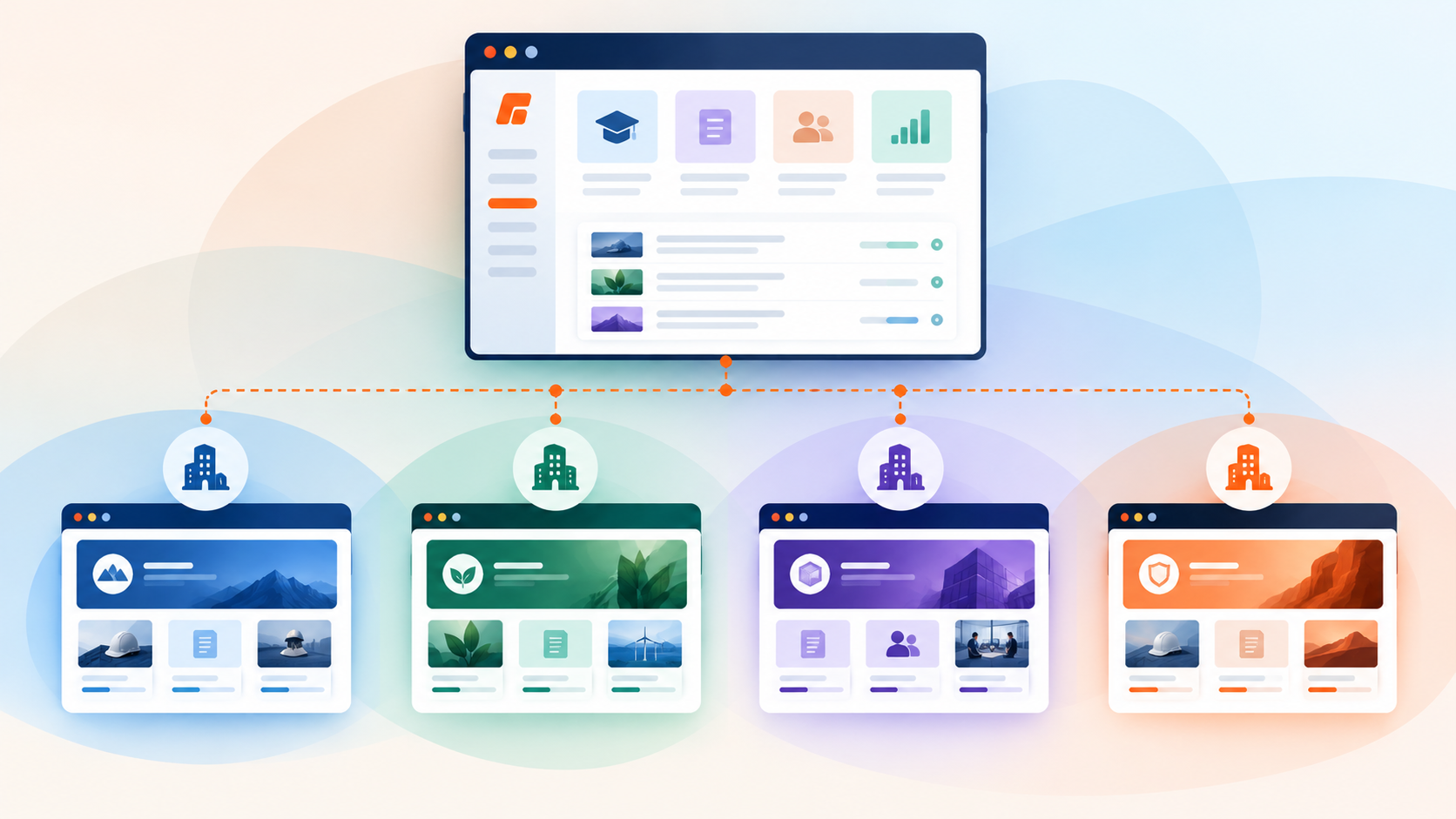
If you sell online training to enterprise clients, a multi-tenant LMS is essential for delivering the branded, secure, and scalable experience they expect. Separate client portals let you create distinct learning environments for each customer, while client-specific user management gives each organization the right level of control over its learners, teams, and administrators.
As your client base grows, a multi-tenant LMS helps you deliver training at scale without rebuilding your setup for every new enterprise account. You can protect each client’s brand and data, support their organizational structure, and create a more consistent experience for the people who manage and complete training.
To meet larger clients’ requirements, you need a multi-tenant LMS with strong data isolation, delegated administration, flexible billing and licensing, and stakeholder-ready reporting. These four enterprise capabilities help you support complex customer needs while growing your training business with confidence.
Why Data Isolation Makes or Breaks Big Deals
Enterprise buyers care a lot about who can see what. If you are in a regulated industry or running annual compliance training, you care even more. If your LMS cannot clearly separate one group’s data from another, your customer’s security team may slow or stop the deal.
Data isolation usually shows up in a few ways:
- Separate branded portals for each client or division
- Clear walls so one client never sees another client’s learners or results
- Role-based access so even inside a portal, different groups stay separate
- Content controls so shared courses never expose private data
Many multi-tenant LMS platforms blur these lines. They might use one big shared catalog where courses and reports sit side by side for all clients. Or they might give you global reports that mix learners from different organizations. It feels simple at first, until a large client asks who else can see their data and you do not have a clear answer.
Strong isolation lets you walk into big meetings with confidence. You can say yes to questions like, “Can we keep subsidiaries separate?” or “Can our outside partners use the same content without seeing our internal staff?” That is when your LMS starts to look like the best platform to sell courses online for security-focused customers, without you rebuilding your setup for every single deal.
Delegated Admin That Lets Clients Run Their Own World
Once you sign an enterprise client, they usually do not want to email you every time they hire someone or move a manager. They want their own admins to run their own world inside your LMS.
True delegated administration means:
- Client-side admins can add users, reset passwords, and manage enrollments
- Local admins can control only their region, department, or partner group
- Admin roles can match your customer’s org chart, even when it shifts
- You can limit who sees reports, catalogs, and settings
Many systems offer a basic “sub admin” role. The problem is, it is often all-or-nothing. Either the sub admin can touch everything, including areas they should never see, or they are stuck sending support tickets for simple changes. That slows things down on your customer’s side and buries you in busywork on your side.
When your LMS supports layered admin levels, things feel different. Global admins at your customer can control high-level settings. Regional admins can watch their own staff. Managers can see just their teams. You stay in control of the platform, but your customers handle their daily operations themselves. That is how you scale without growing a huge internal support team that spends all day on user edits.
Billing and Packaging Built for Enterprise Sales Cycles
When you talk to large organizations late in their budget cycle, the way you bill matters as much as the content you sell. They need to know how licenses are counted, how renewals work, and what happens if their usage spikes.
Your LMS should help you support different approaches, like:
- Per seat models, where licenses are assigned to named users
- Active user or consumption models, where you track real activity
- Bundles of courses or programs that can be sold as packages
- Contract-specific rules, like limits per region or division
If your platform only understands one way to sell, you end up wrestling with spreadsheets and manual checks. You might sell 500 seats to one business unit and 200 to another, then have no clean way to keep those licenses separate. That turns renewal time into a guessing game.
Flexible billing and license management inside the LMS keeps things clear. You can set allocations, see usage by client, and know when licenses are close to expiring. Features like automated seat assignments, expiry alerts, and clean license reports mean you can walk into annual review meetings with solid data on how your courses are used, not a patchwork of exports and guesses.
Reporting That Matches Enterprise Stakeholder Demands
Reporting is where many LMS deals are won or lost. When Q3 and Q4 reviews start, different people at your customer want different views on the same training.
You will see needs like:
- HR teams asking for completion rates and overdue lists
- Managers asking for team progress by course or by deadline
- Executives asking for high-level rollups by region, brand, or business unit
- Compliance and audit teams asking for timestamped records and proof of delivery
If your LMS only has a few fixed reports or simple filters, you end up exporting data and rebuilding it in spreadsheets. That gets tiring fast. It also makes you look more like a basic content vendor than a serious training partner.
Stronger reporting means:
- Client-level dashboards that update without manual work
- Views that match org structure, not just course lists
- Easy filters for date ranges, locations, job roles, and supervisors
- Downloadable files that hold up to internal checks and board updates
When your platform can answer the classic “Can you show us this by region, then by department, then by manager?” question in just a few clicks, you move into a different class. You become easier to renew, easier to expand, and harder to replace.
Turn Your LMS Into an Enterprise-Ready Revenue Engine
If you want to grow your training business, it helps to think like your largest customers. They expect four quiet, powerful things from any platform they let near their people and data: strong data isolation, real delegated admin, flexible billing, and layered reporting that mirrors their structure.
Take a hard look at your current LMS. Are you already running into issues with shared data, all-or-nothing admin roles, messy license tracking, or reports that never quite match what your customers ask for? Those pain points tend to get louder, not quieter, as you add more big names to your client list.
A white-label multi-tenant LMS that is truly built for training companies lets you keep your brand, protect your business model, and still meet enterprise expectations without custom development every time you close a new deal. When your platform can act like an enterprise product inside each client’s world, it becomes the best platform to sell courses online for the kind of B2B accounts that grow with you year after year.
Turn Your Expertise Into a Scalable Revenue Stream
At Firmwater, we make it simple to launch, manage, and grow your course business without technical headaches. Tell us about your goals and we will help you choose the right setup and features. If you have questions or want a tailored walkthrough, you can book a demo.