


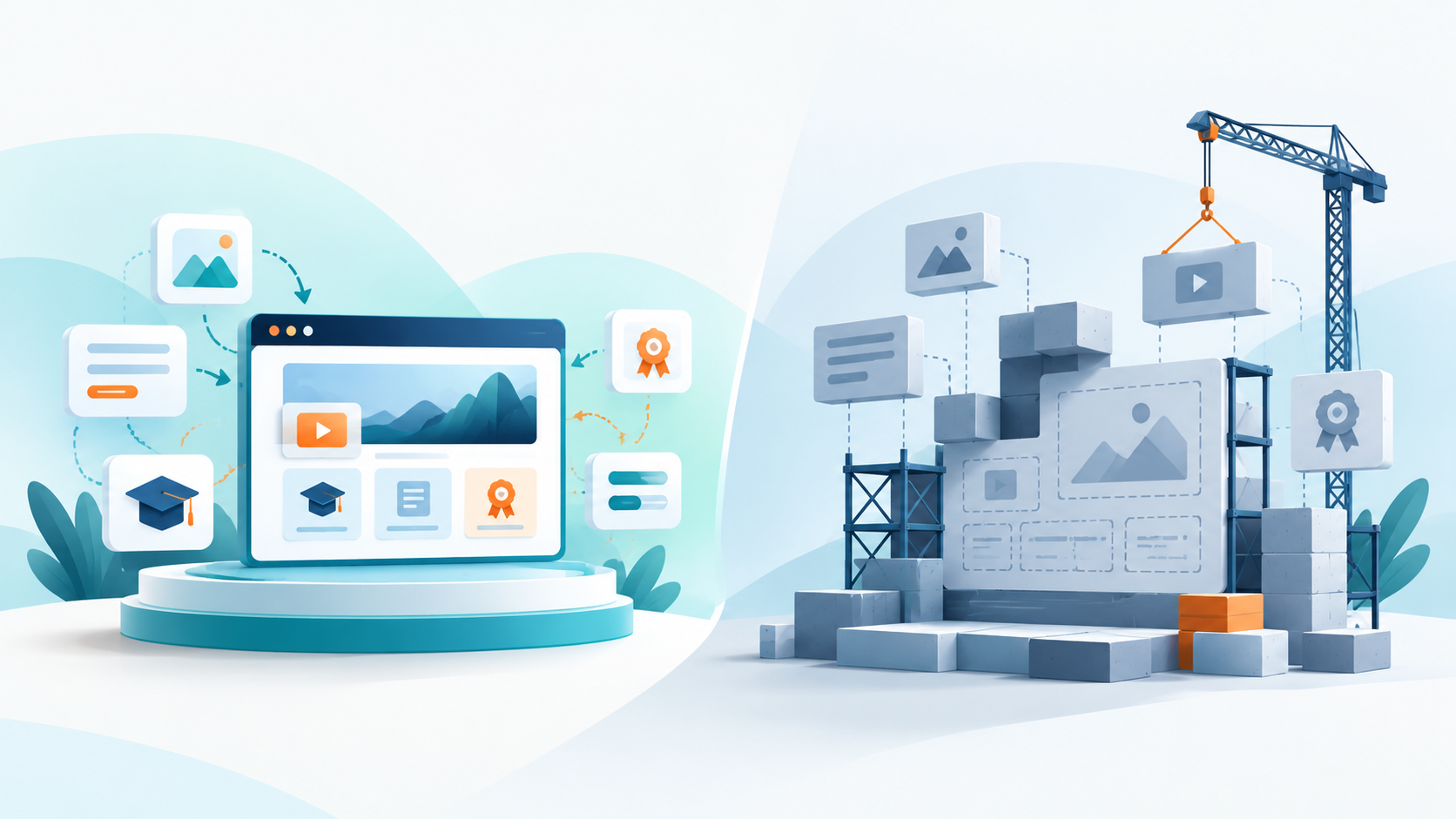
A white-label LMS and a custom-built LMS offer different ways to deliver training under your business brand. A white-label platform can help you launch with established technology, while a custom-built LMS gives you more control over specialized workflows, integrations, and design.
If you sell training to multiple business clients, you may also need separate client environments, often known as multi-tenancy. Multi-tenancy is distinct from white-labeling: white-labeling focuses on how the LMS is presented under your brand, while multi-tenancy can support separate client portals, learner access, and administration.
Give Every Client a Branded Training Home
White-labeling means presenting the LMS under your training provider brand, including your logo, colors, domain, and branded emails. This can create a more consistent experience for learners and help your training business present its courses as part of your own service.
White-labeling does not automatically give every business client its own portal or client-specific branding. Separate client portals, isolated learner access, and branding for individual business clients require additional capabilities, such as multi-tenancy. A portal strategy should consider more than the visual design. Think about whether the platform supports the following requirements in addition to provider branding:
- Separate learner access for each client
- Client-specific course catalogs and enrollment management
- Self-paced and SCORM course delivery
- Reporting for client administrators
- Future training programs and account growth
Compare Custom Development and Platform-Based Delivery
Custom development has a clear appeal. You can shape a portal around unusual workflows, specialized integrations, or a very specific visual design. If your training business has requirements that established systems cannot support, building your own platform may seem like the path to full control.
That control also creates a long-term responsibility. A custom portal needs discovery work, design, development, testing, hosting, security attention, accessibility review, integrations, and support. After launch, the work continues as browsers, payment needs, security expectations, and client requests change.
Time matters, too. A custom portal can take months to plan and launch, which may slow down a new client relationship or delay a training initiative with a firm deadline. A platform-based white-label LMS can start with established learning tools already in place, although learning, administrative, reporting, e-commerce, and business capabilities vary by platform and should be evaluated against your requirements. This can let you spend more time delivering training instead of creating the underlying technology.
See How a White-Label LMS Supports Clients
White-labeling means operating and presenting the LMS under your training provider brand. For training providers that sell courses to organizations, a platform with multi-tenant functionality can also support separate client environments for business clients.
Depending on the platform and program requirements, each client environment may have its own identity and learner experience. That may include its own logo, colors, URL options, course catalog, learner access, and administrative settings. These capabilities can provide a more professional experience than asking every client to work inside one generic portal.
A platform-based approach can also provide capabilities that are easy to overlook when planning a custom build. Depending on the platform and program requirements, you may evaluate or access:
- SCORM content delivery
- Learner enrollment and access management
- Self-paced course experiences
- Course activity and completion reporting
These capabilities can help you package training as a fuller service. When clients can see participation, add learners, and access more relevant courses, it is easier to build ongoing training relationships instead of treating each course sale as a one-time event.
Plan for Scale Across Client Portals
Growth changes the way portal management feels. Running a few client portals manually may be workable at first. As more clients come onboard, separate spreadsheets, separate processes, and custom code for each account can create extra work for your team.
Multi-tenancy is a separate platform capability that can let you manage distinct client environments from a central system without recreating your entire technology setup for every account. White-labeling addresses how the LMS is presented under your provider brand. Together, these two capabilities can create a branded training ecosystem.
When a platform includes centralized administration, everyday work becomes easier to repeat. You can upload and update SCORM courses, enroll learners, manage access, review progress, and prepare reports through a more uniform process across accounts. That consistency can help your team avoid reinventing the wheel whenever a new client launches.
Reporting deserves special attention. Business clients often need clear records of learner progress, course activity, and completions. Those reports can show participation in a training program and help clients decide where they may need additional learning support. They can also help you spot accounts that may be ready for new courses or another branded portal.
Choose the Right Path for Your Training Business
Custom development can make sense when your portal depends on proprietary functions that available platforms do not support. It is also a more realistic option when you have an experienced product and engineering team that can own the work for the long haul.
For many training providers, a white-label LMS is the stronger fit when the goal is to operate training under your own brand, launch sooner, reduce technical overhead, and use platform capabilities that match your requirements. If you need separate client environments, evaluate multi-tenancy and related client-portal capabilities separately from white-labeling. The focus stays on selling and delivering courses, rather than maintaining a growing piece of custom software.
Before choosing, compare each option against the way you plan to serve clients. Consider how quickly you need to onboard accounts, how often courses change, what reporting clients expect, whether you need separate client environments, and whether your team is ready to maintain technology over time. A strong portal strategy should protect the quality of your training experience while making growth easier to manage.
Deliver Branded Training at Scale
Firmwater helps training providers deliver courses to business clients under their own brand. Explore Firmwater’s white-label LMS offering to see how it can support your training business. Book a demo to discuss how your client portal strategy can fit your training business.